Nonpartisan Elections Come to Louisville
Louisville's 2026 metro council and mayoral elections will be nonpartisan for the first time following a law passed by the Kentucky Legislature in 2024.

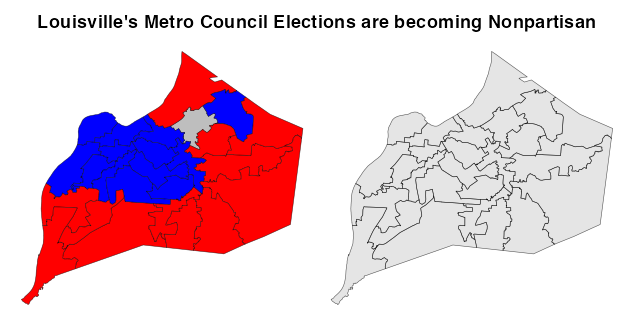
Louisville's 2026 metro council and mayoral elections will be nonpartisan for the first time following a law passed by the Kentucky Legislature in 2024. The 2026 election cycle is the first time Louisville elections will be held under the new nonpartisan framework. The mayor and all odd numbered council districts will be up for election.
Cities across the U.S. are mixed in whether or not their local legislative elections are partisan. Many are officially nonpartisan but still shaped by party dynamics. This is the most likely state for Lousville's upcoming elections, as candidates can still identify themselves with political parties, but those parties won't be officially listed on the ballot.
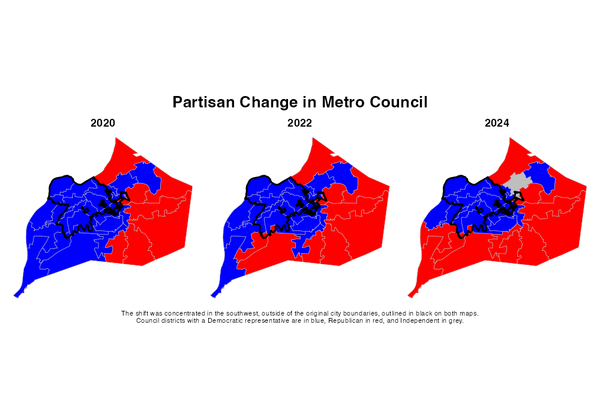
Louisville Metro Council currently consists of 13 Democrats, 12 Republicans, and 1 independent. The council has had a Democratic majority since the city-county merger in 2003.
The state law requiring nonpartisan elections in Louisville was controversial when passed and became law after the Kentucky General Assembly overrode the veto of Kentucky Governor Andy Beshear, who wrote in his veto:
The structure of Louisville Metro Government was democratically created by the people of Jefferson County through the popular vote of the people of Jefferson County...Letting the people decide their form of government is a basic tenet of democracy.
Partisan Implications of the Shift
Although elections will officially be nonpartisan, parties are still operating and looking for advantage. Republicans are hoping to take the majority of the council in 2026, looking to flip districts 7, 17, and 21 after flipping two seats (13 and 25) in 2022 and then three more in 2024 (12, 14, and 24).
The most likely consequence of a shift to nonpartisan elections is to provide a slight advantage to the minority party in the area. As Civic studies professor Brian Schaffner told NPR, "most people want to vote for candidates of the party they support, but when you remove that cue [party names on ballots] it makes it harder for them to do that."
This potential advantage for Republicans - as the current minority party in Louisville - is the most likely explanation for the partisan history of the law, with a Republican state legislature overriding a Democratic governor to change local election law in a city with a Democratic majority.
Although candidates are still allowed to identify themselves with political parties, the potential for confusion is not purely hypothetical, as University of Kentucky political science professor Stephen Voss recounted in a story of a Lexington election in 2018 to the Courier Journal in which looking at voting patterns showed that assumptions made about the candidates based on their backgrounds led to people voting for the candidate who did not share their policy priorities. As Voss told the Courier Journal:
if you looked at how people actually voted, at the precinct data, a whole lot of people got it wrong. They voted for the candidate who, policy-wise, was farther from them.
Voter Turnout and Name Recognition
Although there is a reasonable expectation that not having party cues may cause fewer people to vote by making it harder to decided between candidates, a recent literature review on local elections shows mixed results on if nonpartisanship reduces turnout. The largest factor in voter turnout is election timing, with elections that are do not co-occur with national elections having substantially lower turnout.
In the absence of party cues, name recognition, including the name recognition of being the incumbent becomes more important, and incumbents in nonpartisan races are heavily advantaged.
2026 Election Filings and Voting
The Jefferson County Clerk - which itself remains a partisan elected office - has provided additional information on how the nonpartisan law will impact primary and general elections in Louisville.
NPR provides a list of the candidates who filed for elections in 2026.